
The Hidden Cost of Typing Your EFTPOS Amount Twice
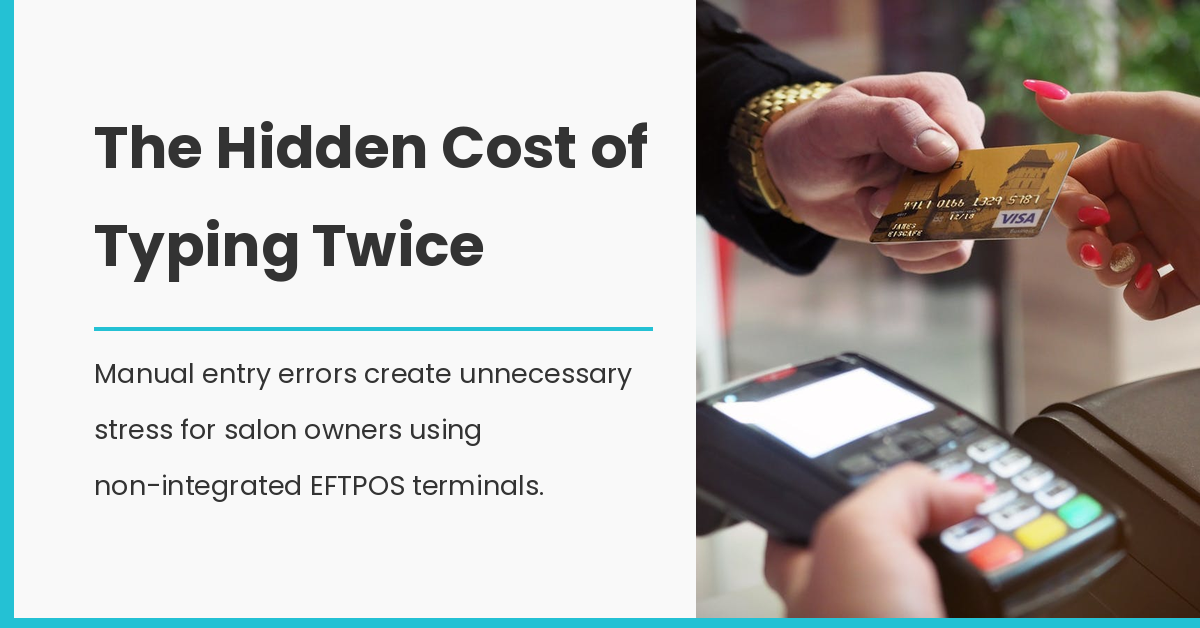
It’s a scenario every salon owner knows.
Your client’s in the chair. Service is done. They head to the front desk and your staff member pulls up the invoice in your salon software, $185 for a colour and cut. Then they turn to the EFTPOS terminal and type in $185.
Or they think they do.
Maybe it’s $18.50. Maybe it’s $195. Maybe the client’s already tapped before anyone notices.
This is double-keying. And it’s quietly costing Australian salons far more than most people realise.
What Is Double-Keying, and Why Does It Happen?
Double-keying happens when your salon software and your payment terminal aren’t connected. Your software knows the total. But your terminal doesn’t. So someone has to manually bridge the gap by typing the amount across.
It sounds simple. But under pressure (a busy Saturday, a full waiting room, a phone ringing) it’s easy to hit the wrong key.
And it happens more than you’d expect.
A study of integrated versus standalone EFTPOS found that manual entry errors are the number one pain point cited by businesses using non-integrated terminals. We’re not talking about catastrophic mistakes. We’re talking about the small, frequent ones: a transposed digit here, a decimal in the wrong place there.
Each one takes time to fix. Each one creates a moment of friction with your client.
The Real Cost: It’s Not Just the Money
The obvious cost of a payment error is the money: a refund, a shortfall, an awkward conversation at the desk.
But there are hidden costs that add up just as fast.
Time. When the terminal total doesn’t match your software at end of day, someone has to find the discrepancy. That might be 10 minutes. It might be 45. It’s time you’re paying for.
Client experience. Even a small hiccup at checkout leaves an impression. Your client just spent two hours and $185 in your salon. The last thing they should feel is awkward while a staff member apologises and processes a correction.
Staff confidence. Your team didn’t get into hairdressing to manage payment reconciliation. When checkouts go wrong repeatedly, it adds stress to their day.
Financial accuracy. If your terminal totals and software totals don’t match regularly, your reporting isn’t reliable. And unreliable reporting makes it harder to make good decisions about your business.
The Fix Is Simpler Than You Think
Here’s the good news: this is a solved problem.
Integrated payments connects your salon software directly to your EFTPOS terminal. When a client is ready to check out, Simple Salon sends the amount straight to the terminal. Your staff member doesn’t type anything. The client taps. Done, in under two seconds.
No manual entry. No transposed digits. No end-of-day discrepancies.
The amount that leaves your software is exactly the amount that hits the terminal. Every time.
Simple Salon integrates with Tyro and ANZ Worldline, two of Australia’s most trusted payment providers, so you’re not switching to an unfamiliar system. You’re just connecting the one you already have.
Is Your Salon Still Double-Keying?
If your EFTPOS terminal is standalone (not connected to your salon software), then yes, every payment in your salon involves manual entry.
Some questions worth asking yourself:
- How often does your end-of-day reconciliation take longer than it should?
- Has a staff member ever keyed in the wrong amount?
- Do your terminal totals always match your software at close of day?
If any of those give you pause, you’re not alone. The vast majority of Australian salons are still running standalone terminals. Not because integrated payments is hard, but because most people don’t know it’s available, or assume it’s complicated.
It isn’t.
On the Blog
Over the coming weeks, we’re unpacking everything you need to know about integrated payments: what it is, how it works in Simple Salon, and what it looks like in real salons that have made the switch.
If payment errors, end-of-day stress, or reconciliation headaches are part of your week, you’re in the right place.
Because you’ve earned a checkout process that just works.